Milk Storage Basics at Home
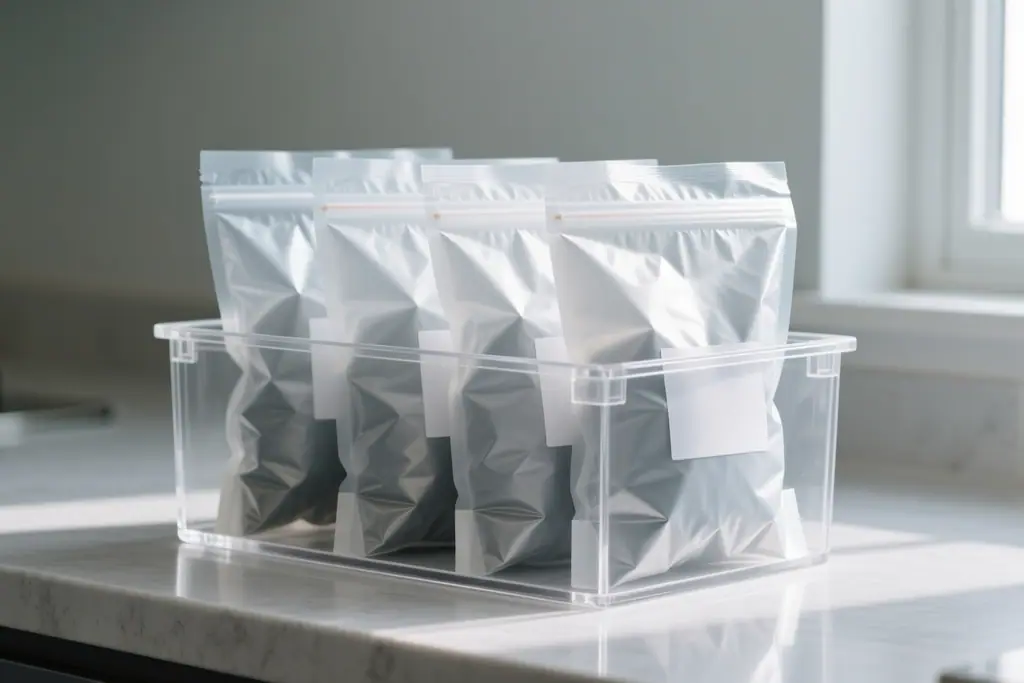
Storing milk well is the quiet work behind every donation and every feed. A family that pumps, keeps and later handles milk needs containers, labels and a freezer that it can actually find things in. Good storage does not require expensive equipment; it requires habits that stay the same from one week to the next. This article covers the basics of keeping milk organised at home, whether it is destined for your own baby or for donation.
Why storage habits matter
How milk is stored affects how easily it can be used later. Clear labels, clean containers and a consistent system make it possible to hand milk to another family with confidence, or to find the oldest milk in your own freezer without turning the whole thing over.

The alliance does not pasteurize milk, so the habits around collection and storage carry more weight, not less. They are what keep a donation straightforward for everyone who handles it after it leaves the house.
A little order at the start saves a lot of doubt later. That is the whole argument for storage basics, and it applies just as much to a personal stash as to a donation.
Choosing containers
Milk can be stored in containers designed for it, whether rigid bottles or flexible storage bags. What matters is that the container is clean, closes well and is meant for holding milk. Reusing a container that was not designed for storage invites leaks and confusion.
It also matters that the container suits the amount. A family that freezes a large volume in one package may end up thawing more milk than it needs, while small, single-feed packages are easier to use flexibly.
Donors who want guidance on which containers to use can find it in the alliance's documents, along with the handling notes that apply specifically to donation.
Labelling that stays readable
A label is only useful if it can still be read after weeks in a freezer. Write the date the milk was collected, and add any note that would matter later, such as whether a medication was being taken. Faded or smudged labels defeat the purpose.
It helps to label before the milk is frozen, when the surface is easy to write on. A marker made for freezer use holds up better than ordinary ink, and it saves a family from guessing later.
For donated milk, labelling is not optional. Milk that cannot be identified is difficult to pass on, which is why the alliance asks donors to keep their labels clear and consistent from the start.
Organising the freezer
A freezer works best when its contents move in a predictable direction. New milk goes to one side or one basket, and older milk is drawn from the other, so that nothing is forgotten at the back and nothing old is left to be discovered by surprise.
Grouping milk by date makes the oldest easy to find, which is exactly what a family needs when it wants to use what it stored first. The same grouping helps a donor see how much is available to give.
Space is finite, so it pays to keep the system honest. When the freezer fills, the family knows it is time to use milk, donate it or adjust how much it collects.
A workable freezer system comes down to a few repeated habits:
- Put new milk at one end and take older milk from the other.
- Group packages by date so the oldest is easy to reach.
- Keep a clear gap between home milk and milk set aside for donation.
- Check the freezer before adding more, so nothing gets buried.
- Use the oldest milk first, whether at home or before a pick-up.
Keeping donated milk separate
Donated milk should be kept apart from the milk a family plans to use for its own baby. Separation prevents mix-ups and makes it clear which packages are meant to leave the house. It also makes the donation easier for a volunteer to check at pick-up.
Keeping the two streams apart is one of the simplest habits in the whole process, and one of the most useful. The table below shows how the two kinds of stored milk differ.
| Point | Milk for your own baby | Milk for donation |
|---|---|---|
| Purpose | Feeds your household | Passed to another family |
| Storage | In your usual freezer space | Kept clearly separated |
| Labelling | Helpful for your own order | Essential, with dates and notes |
| Handling guidance | Your own routine | Follow the alliance documents |
| Extra step | None | Screening before sharing begins |
Clean hands and clean surfaces
Cleanliness is the base layer of storage. Wash hands before handling containers or pumping equipment, and keep the surfaces where milk is poured or packed clean. These are basic habits, and they carry real weight when milk will be shared.
Containers should be closed properly and stored so that they are not damaged by other items. A torn bag or a cracked lid can waste a whole package and complicate a donation that was otherwise ready.
Beyond the general habits, families should follow the specific guidance in the alliance's documents, which covers collection and handling in more detail than a short article can.
Simple habits that last
Storage does not reward complexity. The families who manage it well use the same few habits week after week: clean containers, readable labels, a freezer that moves in one direction, and a clear line between milk for home and milk for donation.
Those habits also make the rest of the alliance's process easier. Screening, pick-up and handling guidance all assume that the milk is identifiable and well kept, and a family that stores well moves through each step with less friction.
If a storage question touches on whether milk is still suitable for your baby, that is a clinical question, not a filing one. Talk with your pediatrician, midwife or lactation consultant, and use the alliance's documents for the parts that are about handling rather than health.
Related reading
Thawing and Warming Safely
How frozen milk is thawed, what to avoid and why the sequence matters.
Flash-Heat Pasteurization at Home
What the documented home method involves and where the instructions live.